
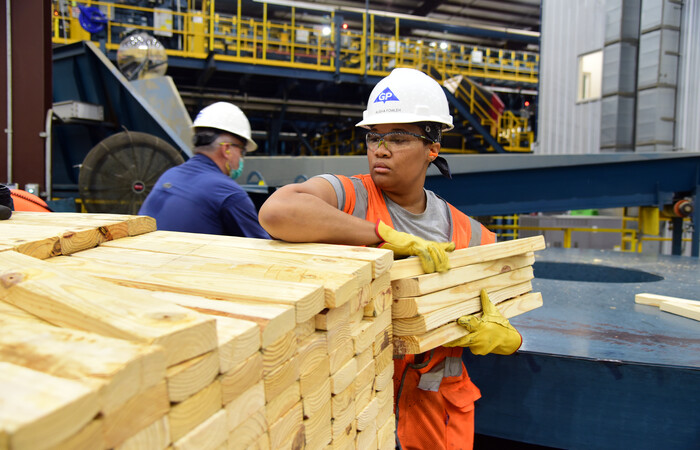
Wood is integral to our lives. It is used to build our homes, decks, flooring, roofs, furniture, and tall buildings. Wood is a high-performance, cost-effective material that’s increasingly in demand.
Types of Wood Products
Lumber
Lumber comes from trees that have been turned into planks or boards. Lumber is commonly used in structural materials, called framing lumber, like your traditional 2x4.
It is also used in:
- Cabinetry
- Furniture
- Flooring
- Pallets
- Decking
Engineered Wood Products
Engineered wood products are manufactured with a combination of wood or sawmill leftovers and various adhesives. Sawmill leftovers can include sawdust, chips, stumps and other scrap wood.
Examples of engineered wood products include:
- Plywood
- Particleboard
- Medium density fiberboard (MDF)
- Laminate flooring
- Structural composite lumber (SCL)
Member Spotlight
Watch on YouTubeEver wonder how lumber is made? Georgia-Pacific explains the process in 60 seconds.
Mass Timber
Mass timber is an innovative building material that allows for the construction of buildings taller than traditional light frame methods. It’s a strong, low-carbon alternative to concrete and steel.
Mass timber buildings are safe, durable and resilient. Mass timber buildings:
- Meet the same level of fire performance and comply with fire codes as buildings made from alternative materials.
- Can be designed to withstand high winds and earthquakes.
- Store carbon. The carbon stored in a tree stays locked away in the finished materials for decades or centuries.
Types of mass timber include:
- Cross-laminated timber (CLT)
- Glued-laminated timber (glulam)
- Nail-laminated timber (NLT)
- Dowel-laminated timber (DLT)
Did You Know
Learn More From Oregon State UniversityResearchers found that substituting wood for concrete and steel in commercial buildings cut GHG emissions by an average of 60%.
Using Wood Products in the Built Environment
The American Wood Council is the nationally recognized technical authority for sustainable wood building products.
Interested in resources about codes, standards, green building policy and wood design?